
Best Programmatic Advertising Platforms for B2B Targeting (2026)
TL;DR
Global programmatic ad spend is on track to reach $725 billion in 2026, roughly 90% of all digital display advertising. For B2B teams, programmatic is the fastest way to put your message in front of specific accounts and decision-makers across display, video, native, and connected TV. The right platform depends on your team size, budget, and how much you want to run yourself. For mid-sized B2B companies with lean marketing teams, managed services like Hey Sid deliver done-for-you, person-level advertising without the complexity of a self-serve DSP. For enterprise teams with dedicated ad ops, The Trade Desk and StackAdapt give the most control. This guide ranks and compares the top 12 programmatic advertising platforms built for, or well suited to, B2B targeting in 2026, with real pricing, strengths, limitations, and a recommendation framework based on team size and budget.
Related: Programmatic Advertising for B2B: Complete Guide I B2B Retargeting Ads: How to Re-Engage Buyers Across the Funnel
Not all programmatic platforms are built for B2B. Consumer-focused DSPs assume you want massive reach across anonymous audiences. B2B campaigns need the opposite: precision targeting of a small, defined set of accounts and the people inside them, sustained over a long buying cycle. The platforms below are ranked by how well they serve that need, from person-level managed execution to enterprise self-serve DSPs, so B2B and B2B SaaS teams can find the right fit whether they run campaigns in-house or want them handled end to end.
The 12 Best Programmatic Advertising Platforms for B2B Targeting in 2026
1. The Trade Desk - The leading independent DSP for enterprise programmatic
Type: Independent self-serve DSP | B2B focus: Secondary | Pricing: ~$20,000+/month minimum
The Trade Desk is the dominant independent DSP, processing more than 13 million ad impressions per second. Its Koa AI bidding engine and Unified ID 2.0 identity framework make it the platform of choice for large advertisers and agencies running global programmatic campaigns. It is known for transparency, data access, and the broadest channel coverage of any independent DSP: display, video, CTV, native, audio, DOOH, and in-game.
Why it works for B2B
GPS-based geofencing at no additional CPM cost, plus geoframing to retarget past location visitors
IP targeting through partner data integrations to reach employees at named companies
CTV advertising reaches B2B decision-makers in premium streaming environments
Audience Unlimited uses AI to score and activate third-party segments
Full transparency into bidding, fees, and media costs, with a 200+ integration data marketplace
Limitations
Requires a trained ad ops team or agency to operate, with a ~$20K+/month minimum spend
No native B2B account-level targeting; you must layer in third-party B2B data
Steep learning curve for teams new to programmatic
Custom reporting scores below average on G2 (7.4/10)
Best for: Enterprise B2B teams (marketing team of 10+) with dedicated programmatic buyers, agency support, and $20K+/month display budgets running large-scale, multi-channel campaigns globally.
How it compares to Hey Sid: The Trade Desk offers unmatched control and inventory access but requires a team to operate. For mid-sized B2B companies without ad ops resources, Hey Sid provides person-level targeting and full execution without the complexity.
2. Hey Sid - Person-level B2B targeting with done-for-you execution
Type: Managed, done-for-you advertising service | B2B focus: Primary | Pricing: From ~$1,900/month managed ad spend
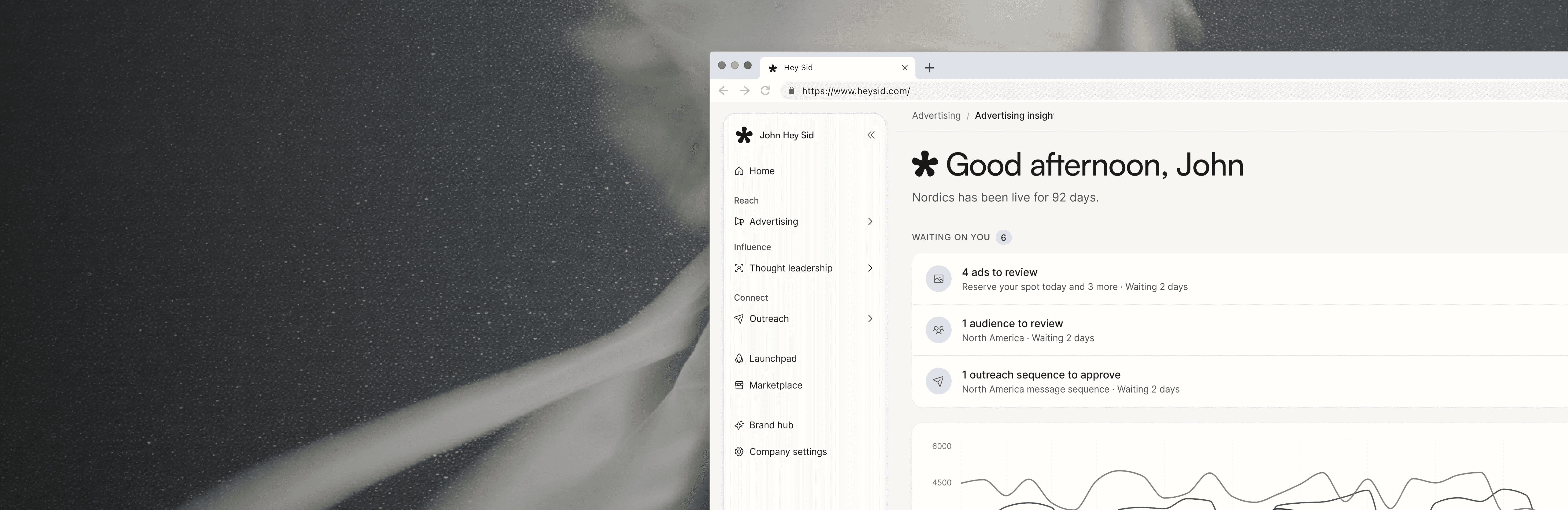
Hey Sid is a person-targeted ad engine built for mid-sized B2B companies. It is not a self-serve DSP: unlike traditional platforms that require an in-house ad ops team, Hey Sid handles everything, including audience identification, creative production, campaign management, and account-level reporting. Every impression is served to a named individual at a target account, not just a company or an IP range, so person-level precision means very little wasted ad spend.
Why it works for B2B
Person-level (individual-level) targeting serves ads to exact target individuals, not just companies, IP ranges, or account-level segments
Multi-channel by default: LinkedIn, Meta, Google, and programmatic display run from a single campaign
Done-for-you creative: 5 ad variations per campaign, refreshed every 60 days, at no extra cost
The Influence Loop coordinates ads (Always On), thought leadership (Authority Builder), and outreach (Precision Connect) to the same individuals
Two-way HubSpot integration - feeds ad-engagement intelligence to sales and pulls CRM companies and deals into ad audiences, with influenced-pipeline, revenue and ROAS reporting
GDPR compliant and European-born, built for European and Nordic B2B markets
No DSP expertise needed: built for marketing teams of 1-3 people
Limitations
Not a self-serve DSP: limited customization for teams that want full control over bidding and placements
Requires a defined target list; not designed for mass awareness campaigns
Minimum monthly ad spend of $1,900/month
No G2 listing yet (founded 2024)
Best for: Mid-sized B2B companies (20-100 employees) with long sales cycles (6-18 months), lean marketing teams, and consultative selling motions. A particularly strong fit for Nordic and European markets.
Proof points
Mercuri International reduced as spend by 85% and attributed one of its biggest deals in a decade to Hey Sid.
Devotion Ventures booked 45+ qualified meetings in four months with shorther sales cycles.
Risk Ident saw 2.5x shorther sales cycles and 40% higher engagement, fully GDPR compliant.
3. StackAdapt - Mid-market self-serve DSP with strong B2B targeting
Type: AI-powered self-serve DSP | B2B focus: Secondary | Pricing: CPM-based, ~$5,000/month minimum
StackAdapt has become the fastest-growing DSP among B2B advertisers and agencies, and holds a strong reputation for B2B targeting. It combines native, display, video, CTV, audio, in-game, email, and DOOH formats with ABM targeting. In 2025 it launched Ivy, an in-platform AI assistant for campaign optimization, and its Data Hub enables first-party data activation and account-based targeting.
Why it works for B2B
Pre-built ABM account targeting using firmographic, technographic, demographic, and intent data
CRM data upload for audience matching, plus contextual AI targeting that works without cookies
Machine-learning bid optimization and strong native ad formats that blend with editorial content
Lower barrier to entry than The Trade Desk (~$5K/month vs. $20K+)
Ranked highest in customer satisfaction on G2 for six consecutive years
Limitations
Requires in-house ad ops expertise to manage campaigns
Smaller data marketplace than The Trade Desk; reporting can be glitchy per G2 reviews
Platform fees are not always transparent until invoicing
No person-level targeting (account-level only)
Best for: B2B marketing teams of 3-10 people with some programmatic experience and $5K-$15K/month display budgets. The go-to mid-market option.
How it compares to Hey Sid: StackAdapt gives you more control over bidding, placements, and channel mix, but you need internal resources to operate it. Hey Sid is the better fit for lean teams that want execution handled for them and person-level, not just account-level, targeting.
4. Demandbase - ABM platform with a built-in B2B DSP
Type: Unified ABM platform with native B2B DSP | B2B focus: Primary | Pricing: Custom; ~$18K to $32K/year SMB, up to $100K-$300K+ enterprise
Demandbase operates one of the only B2B DSPs built from the ground up for B2B advertising, with no minimum ad spend threshold for DSP access. It combines account intelligence, intent data, programmatic advertising, and sales intelligence in one system, using account identification to target display, video, and CTV ads to people at target accounts.
Why it works for B2B
Native account-based advertising without data layering, with intent data integrated into ad targeting
Person-level targeting through "Person Intent" signals, plus buying-group identification (launched July 2025)
Website personalization for target accounts and strong firmographic and technographic targeting
Integrates with Salesforce, HubSpot, and major marketing automation tools
G2 rating of 4.4/5 from 1,916 reviews, Leader in 38 G2 reports, support score 8.7/10
Limitations
Complex platform with a steep learning curve; implementation takes 3-6 months
Enterprise-level pricing ($18K to $300K+/year), not designed for mid-market budgets
Targeting is largely account-level; can be overwhelming for lean teams
Attribution reporting can be difficult to configure
Best for: Mid-to-large B2B enterprises ($50M+ revenue) with dedicated marketing operations or ABM teams that want intent data and advertising in one platform.
How it compares to Hey Sid: Demandbase is a platform you operate; Hey Sid is a service that operates for you. Demandbase targets accounts; Hey Sid targets individuals. For mid-sized teams, Hey Sid is simpler to adopt and faster to show results.
5. 6sense - Predictive ABM plus advertising
Type: Revenue intelligence platform with B2B DSP | B2B focus: Primary | Pricing: Custom; median ~$55,211/year, range $35K to $300K+
6sense analyzes more than 500 billion intent signals to predict which accounts are in-market, then activates its built-in DSP against them. Its advertising module targets accounts showing buying signals, making it strong for demand capture, and now includes CTV advertising with 90%+ completion rates (launched Fall 2025).
Why it works for B2B
Industry-leading predictive intent data and buying-stage predictions that identify accounts before they self-identify
AI-powered audience recommendations and Revenue AI that maps buying-committee engagement stages
Display and LinkedIn advertising in-platform, plus CTV to reach decision-makers on streaming
RevvyAI (November 2025) adds agentic AI for automated campaign execution
Named a Leader in the Forrester Wave, Q1 2025
Limitations
Steep learning curve requiring dedicated RevOps expertise
Expensive (median ~$55K/year, often $100K+ with modules)
"Black box" scoring with limited transparency
Account-level targeting only, with no person-level precision; no built-in engagement tools
Best for: Enterprise ABM teams ($100M+ revenue) with dedicated RevOps staff and six-figure martech budgets.
How it compares to Hey Sid: 6sense excels at identifying which accounts are in-market. Hey Sid excels at reaching the specific people at those accounts with coordinated ads and outreach, and doing it without requiring a RevOps team.
6. Google Display & Video 360 (DV360) - Best for Google-ecosystem teams
Type: Enterprise DSP (Google Marketing Platform) | B2B focus: Secondary | Pricing: Platform fee + CPM; requires GMP agreement
DV360 is Google’s demand-side platform, offering access to the Google Display Network plus premium programmatic inventory. Its integration with GA4, Campaign Manager 360, and Search Ads 360 enables unified measurement, and it is the default DSP for many agencies and large advertisers.
Why it works for B2B
Direct access to YouTube inventory for video advertising, not available on most third-party DSPs
Unified audience targeting with GA4 website behavior data and advanced frequency management across Google properties
Programmatic guaranteed deals alongside open-auction buying
15-25% CPA improvement possible over 60-90 days as GA4 signals mature
Limitations
No native B2B targeting (no account identification); requires external data layers or an ABM platform
Complex setup and steep learning curve; requires a Google Marketing Platform agreement
Less transparent than independent DSPs, with concerns around Google prioritizing its own inventory
Better suited to B2C-scale campaigns
Best for: Enterprise B2B teams already invested in the Google Marketing Platform ecosystem who need YouTube and display at scale, ideally alongside a B2B data layer.
How it compares to Hey Sid: DV360 is a general-purpose DSP with no B2B-specific targeting. Hey Sid is purpose-built for B2B individual targeting. DV360 makes sense for teams that already hold GMP contracts and need broad reach alongside their ABM stack.
7. Metadata - Automated B2B demand generation across paid channels
Type: B2B demand-generation automation platform | B2B focus: Primary | Pricing: SaaS subscription + ad spend (custom, minimum spend)
Metadata automates B2B paid campaigns across LinkedIn, Facebook, and display. Its AI handles audience testing, creative rotation, and budget allocation across channels, shifting spend toward the best-performing options with minimal manual work.
Why it works for B2B
Purpose-built for B2B paid campaigns, not general advertisers
Automated audience testing across multiple channels simultaneously, with reverse-IP pretargeting for social
Budget-allocation AI moves spend toward best-performing channels
Revenue attribution and pipeline reporting; strong for teams running LinkedIn Ads at scale
Limitations
Limited to social and display (no CTV, audio, or native)
Requires meaningful existing ad budget to see results from automated testing
Smaller company that has shifted focus multiple times; confirm the current product roadmap
Best for: B2B marketing teams spending $10K+/month on LinkedIn and Facebook who want AI-driven optimization without managing each platform individually.
How it compares to Hey Sid: Metadata automates campaign management but still requires your team to define strategy and produce creative. Hey Sid provides full execution, strategy, creative, and management, with person-level rather than audience-segment targeting.
8. Vibe.co - Self-serve CTV for lean B2B budgets
Type: Self-serve CTV advertising platform | B2B focus: Secondary | Pricing: From $50/day, no annual contract
Vibe.co is a direct, self-serve entry point into CTV without the enterprise price tag. Instead of a $20,000-plus monthly DSP commitment or a $35,000-plus annual ABM platform, a team can buy directly across more than 500 premium channels, including Hulu, Disney+, and ESPN, starting at $50 a day with no annual contract. It answers the common question of what a connected TV programmatic platform costs per month and what minimum spend to expect.
Why it works for B2B
Direct buying across 500+ premium CTV channels (Hulu, Disney+, ESPN) with no DSP layer
Targets first-party audience segments plus lookalikes from an ID graph covering 120M+ households
Performance flows into the same measurement stack (including Triple Whale and Northbeam) used for other paid channels
$50/day entry point makes CTV testable without enterprise budgets or a trained ad ops team
Limitations
CTV-only (no display, native, audio, or search)
Reach via ID-graph lookalikes rather than named account-level or person-level targeting
Best for: Lean B2B teams that want CTV in the mix, on a budget, before committing to a bigger platform.
How it compares to Hey Sid: Vibe.co is a self-serve, CTV-only tool where your team runs campaigns at $50/day using ID-graph lookalikes. Hey Sid is a managed, multi-channel service that serves ads to named individuals at your target accounts from ~$1,900/month, so many teams pair the two: Vibe.co for cheap CTV reach, Hey Sid for person-level targeting.
9. Spotify Advertising - Audio and video reach in the listening moment
Type: Self-serve audio, video & display platform | B2B focus: Secondary | Pricing: Self-serve via Spotify Ads Manager; programmatic via Spotify Ad Exchange
For B2B teams weighing channel coverage, the harder question is where a buyer's attention actually sits when an ad runs. Display and paid social reach people at a screen; audio and video inside a listening environment reach them on a commute, a focus block, or a workout, when a laptop is closed and a decision-maker is off the usual work surfaces. Spotify Advertising is the platform brands and media planners use to reach 761M+ fans across music, podcasts, and audiobooks in 180+ markets, with contextual targeting organized around listener moments rather than demographics alone.
Why it works for B2B
Reaches decision-makers off the work surface: audio and video in commute, focus, and workout moments, when display and paid social can't
Contextual targeting by listener moment (Driving, Focus, Commute, Chill) aligns a campaign to what someone is doing, not just who they are
Multi-format from one platform: audio, video, display, and carousel, with podcast ads that reach Premium listeners as well
Self-serve buying through Spotify Ads Manager, or programmatic buying through the Spotify Ad Exchange
First-party and third-party measurement on the back end
761M+ fans across 180+ markets for broad top-of-funnel reach
Limitations
No native B2B, account-level, or person-level targeting; reach is contextual and demographic, so B2B relevance is layered through moment and context
Better suited to brand awareness and top-of-funnel reach than to direct account or pipeline capture
Audio and video-first consumer platform; B2B is a secondary use case, not the primary design
Pipeline attribution is indirect compared with account-based platforms
Best for: B2B brands and media planners who want to reach decision-makers in audio and video listening moments - commute, focus, workout - for brand awareness and reach beyond display and paid social.
How it compares to Hey Sid: Spotify Advertising is a self-serve channel play that reaches broad, contextual audiences in listening environments. Hey Sid is a managed service that serves ads to named individuals at your target accounts across LinkedIn, Meta, Google, and display. Many B2B teams pair the two: Spotify for off-screen brand reach, Hey Sid for person-level account targeting.
10. InZynk - Nordic self-serve B2B advertising platform
Type: Self-serve B2B advertising platform | B2B focus: Primary | Pricing: EUR 199/month + minimum EUR 100 per target account; 3-month free trial
InZynk (Oslo and Stockholm) is built specifically for B2B account-based advertising, rather than repurposed from a B2C tool. It recently launched Geo Advertising (100 to 1,000m radius geofencing) alongside its company-targeting capabilities, and is one of the few B2B ad platforms with transparent, published pricing.
Why it works for B2B
Company-level targeting by uploading target account lists
Geo Advertising feature for events and office targeting, plus AI-generated ad creative
Website personalization via the LandingZone feature
GDPR compliant with no data transfer outside the EU/EEA; clients include Ericsson, Oracle, and Nordea
Transparent pricing and a 3-month free trial with full access
Limitations
Display-only (no video, CTV, audio, or native)
Smaller platform with limited inventory outside the Nordics and Europe
Company-level targeting only, not person-level
Best for: Nordic and European B2B companies wanting self-serve account-based display advertising with transparent pricing and fast setup.
How it compares to Hey Sid: InZynk is a self-serve tool your team runs, targeting at the company level. Hey Sid runs campaigns for you and targets named individuals across LinkedIn, Meta, Google, and display, so it is the more complete option for lean Nordic B2B teams that want execution handled.
11. BidTheatre - Nordic independent DSP
Type: Independent self-serve DSP | B2B focus: Secondary | Pricing: Annual contract (custom), minimum fee required
BidTheatre (Stockholm, acquired by Vitec Software Group) is a Nordic-focused DSP built for European advertisers. It offers IP-based geo-targeting and broad format coverage including display, video, native, programmatic audio, CTV, and DOOH, with a focus on privacy compliance and regional inventory.
Why it works for B2B
IP-based targeting at country, region, city, and postal-code levels
Programmatic audio on Spotify and Acast reaches commuting professionals
DOOH for out-of-home campaigns, plus Nordic-specific premium inventory
Cleaner self-serve interface than most enterprise DSPs, with strong GDPR compliance
G2 Quality of Support 9.7/10 and Performance 9.0/10; the only Nordic DSP with audio and DOOH
Limitations
IP-based geo only (not building-level geofencing)
Slow insights loading and limited reporting per user reviews
Restricted market coverage outside Scandinavia; pricing not publicly disclosed
Limited B2B-specific targeting (no native ABM); requires in-house campaign management
Best for: Agencies and B2B teams running multi-format programmatic campaigns focused on the Nordic and Northern European market.
How it compares to Hey Sid: BidTheatre is a regional DSP you operate yourself. Hey Sid operates for you and targets at the individual level. For B2B teams in the Nordics, Hey Sid is a more complete solution; BidTheatre suits teams with ad ops resources who want direct DSP control.
12. Basis Technologies (formerly Centro) - Enterprise omnichannel DSP with workflow automation
Type: Enterprise omnichannel DSP | B2B focus: Secondary | Pricing: Enterprise; contact for pricing
Basis Technologies provides an omnichannel DSP that centralizes programmatic, direct, search, and social ad buying in one system. It is designed for complex organizations and agencies that need centralized media buying, approvals, and reporting.
Why it works for B2B
Unified platform for programmatic, direct, and social buying
Strong workflow automation and approval processes
Private marketplace (PMP) advertising emphasis
Granular reporting and data-export capabilities
Limitations
Enterprise-oriented, not designed for lean teams
No native B2B or ABM targeting features
Complex setup and implementation; better suited to agencies than in-house B2B teams
Best for: Large organizations or agencies managing complex, multi-channel media buys across programmatic and direct.
How it compares to Hey Sid: Basis Technologies is a media-buying workflow platform for large teams. Hey Sid is a B2B advertising service for lean teams. Different tools for different situations.
B2B Programmatic Platform Comparison
Platform | Type | B2B focus | Person-level? | Key channels | Starting price | Best for |
|---|---|---|---|---|---|---|
The Trade Desk | Enterprise DSP | Secondary | No | Display, video, CTV, audio, DOOH | ~$20K+/mo | Enterprise with ad ops |
Hey Sid | Managed service | Primary | Yes | LinkedIn, Meta, Google, display | ~$1,900/mo | Lean B2B, managed execution |
StackAdapt | Self-serve DSP | Secondary | No | Native, display, video, CTV, DOOH | ~$5K/mo | Mid-market, 3-10 person teams |
Demandbase | ABM platform + DSP | Primary | Yes | Display, video, CTV | $18K+/year | Mid-to-large ABM teams |
6sense | Revenue intel + DSP | Primary | Limited | Display, CTV | $35K+/year | Enterprise predictive ABM |
DV360 | Enterprise DSP | Secondary | No | Display, YouTube, video, CTV | GMP agreement | Google-ecosystem teams |
Metadata | B2B automation | Primary | No | LinkedIn, Facebook, display | Custom (min spend) | LinkedIn + Facebook optimization |
Vibe.co | Self-serve CTV | Secondary | No | CTV | $50/day | Lean teams, budget CTV |
Spotify Advertising | Self-serve audio/video | Secondary | No | Audio, video, display, podcast | Self-serve (Ads Manager) | Audio/video brand reach |
InZynk | B2B ad platform | Primary | No | Display | EUR 199/mo + EUR 100/acct | Nordic/EU self-serve B2B |
BidTheatre | Nordic DSP | Secondary | No | Display, video, audio, DOOH | Annual contract | Nordic multi-format campaigns |
Basis Technologies | Omnichannel DSP | Secondary | No | Programmatic, direct, search, social | Enterprise | Large orgs and agencies |
Pricing is indicative, based on publicly available information and vendor discovery as of February 2026. Confirm current rates and minimums directly with each provider.
How to Choose a Programmatic Advertising Platform for B2B
Not all programmatic platforms are built for B2B. Consumer-focused DSPs assume you want massive reach across anonymous audiences. B2B campaigns need the opposite: precision targeting of a small, defined audience over a long buying cycle. Use these criteria to evaluate any platform on this list.
B2B targeting depth: can it target by account, industry, job title, or individual person?
Intent data integration: does it connect to intent providers to identify in-market accounts?
CRM and marketing-stack integration: HubSpot, Salesforce, Dynamics 365 compatibility
Creative production: do you produce ads yourself, or is creative included?
Managed vs. self-serve: does your team have the expertise to operate a DSP?
Channel coverage: display, video, LinkedIn, Meta, CTV, Google?
Reporting granularity: account-level engagement data vs. campaign-level metrics only
Minimum spend and pricing model: monthly minimums, CPM-based, or SaaS subscription
Privacy and compliance: GDPR readiness, first-party data support, cookie-free targeting
Onboarding and support: time to first campaign, training, dedicated account management
By team size
1-3 marketers, no ad ops: Hey Sid (done-for-you, person-level) or InZynk (self-serve, account-level, Nordic)
3-10 marketers with some ad experience: StackAdapt or BidTheatre (self-serve with support)
10+ person team with ad ops: The Trade Desk, DV360, or Basis Technologies
Enterprise with RevOps/ABM team: Demandbase or 6sense (full ABM platform with ads)
By budget
$1,900 to $5,000/month: Hey Sid, InZynk
$5,000 to $20,000/month: StackAdapt, Metadata, Hey Sid
$20,000+/month: The Trade Desk, DV360, Demandbase, 6sense
By primary need
"I want someone to run campaigns for me": Hey Sid
"I want to target specific individuals": Hey Sid, Demandbase
"I want full control over my programmatic buying": The Trade Desk, StackAdapt
"I want advertising as part of a full ABM platform": Demandbase, 6sense
"I want CTV without an enterprise commitment": Vibe.co
"I need European/Nordic inventory and GDPR focus": Hey Sid, InZynk, BidTheatre
Your Next Steps
Compare platforms head-to-head against your team size, budget, and technical capability
Start with a 90-day pilot on one platform before committing to an annual contract
If you want person-level B2B advertising without the operational overhead, book a demo with Hey Sid
Read the full guide: Programmatic Advertising for B2B: The Complete Guide for 2026
Activate Always On
Always On keeps your brand visible to the right decision makers every day. Stay relevant throughout long sales cycles without running constant campaigns: individual-based advertising that works in the background. Book a demo to see it in action.
Book a demo or See how it works
FAQ
Which programmatic advertising platform is best for small B2B teams?
Hey Sid is purpose-built for lean B2B marketing teams of 1-3 people. It provides done-for-you campaign execution, including creative production, person-level targeting, and reporting, so you do not need in-house ad ops expertise. For teams that want more hands-on control with automation support, StackAdapt is the next best option, and InZynk is a strong self-serve choice for Nordic and European teams.
Do I need a DSP for B2B programmatic advertising?
Not necessarily. DSPs like The Trade Desk and StackAdapt give you direct control over bidding and placements, but they require ad ops expertise. ABM platforms such as Demandbase and 6sense include built-in advertising with simpler interfaces. Managed services like Hey Sid handle all programmatic buying for you. The right approach depends on your team’s capacity and how much time you can dedicate to campaign management.
What is the minimum budget for B2B programmatic advertising?
Self-serve platforms like StackAdapt start around $5,000/month, and The Trade Desk requires roughly $20,000/month. ABM platforms range from $18K to $300K/year. Managed services like Hey Sid start at approximately $1,900/month in ad spend, and platforms that include creative can reduce your total cost versus a DSP-plus-agency combination. For a meaningful test, plan at least $3,000 to $5,000/month over 90 days.
What is the difference between account-level and person-level programmatic targeting?
Account-level targeting shows ads to anyone at a target company, identified through IP matching, company databases, or identity graphs. Person-level targeting shows ads to specific named individuals at those companies. Person-level targeting produces less waste and creates a stronger connection between advertising and sales outcomes, but it requires a defined prospect list and platforms that support individual matching, such as Hey Sid or Demandbase Person Intent.
Can I run programmatic advertising and ABM from the same platform?
Yes. Demandbase and 6sense combine ABM intelligence with programmatic advertising in one platform. Hey Sid takes a different approach: it targets at the person level rather than the account level and coordinates advertising with outreach and thought leadership. Both work; the question is whether you need an enterprise ABM platform or a focused, person-level advertising service.