
Personal Brand vs Business Brand: What B2B Leaders Need to Know
TL;DR: Personal brands and business brands serve different purposes in B2B. Your business brand positions your product and company. Your personal brand positions you as a trusted expert. In 2026, B2B companies that invest in both generate more pipeline than those that invest in either alone.
Personal profiles get 8x more LinkedIn engagement than company pages, but company brands provide the credibility infrastructure that closes deals. This guide explains when to invest in each, how they complement one another, and how to run them as one coordinated system.
Part of the Personal Branding Hub: Personal Branding Playbook | Why Personal Branding Matters | LinkedIn Personal Branding Strategies
Defining the Difference
Personal brand: How the market perceives you as an individual. Your expertise, perspective, credibility, and reputation. Built through content, conversations, speaking, and visible thought leadership. Owned by you and portable across companies.
Business brand: How the market perceives your company. Your product positioning, value proposition, visual identity, and market presence. Built through marketing, advertising, product experience, and customer success. Owned by the company and tied to the business.
The relationship: Your personal brand opens doors. Your business brand closes deals. Both are necessary. Neither is sufficient alone.
Two Archetypes: The Personal-Brand Signal vs the Business-Brand System
Two well-known brands show the poles of this choice.
Elon Musk - when one person becomes the market signal. Musk's brand is built on visibility, strong opinions, and direct communication. A single post from him can move media narratives and even market attention - his Dogecoin posts repeatedly triggered spikes in trading activity with no marketing campaign behind them. That's the core strength of a personal brand: one voice can shape perception, and one opinion can move attention at scale. A strong personal brand doesn't just communicate - it creates reactions.
Oatly - emotional connection through a business-brand system. Oatly built deep loyalty without leaning on any single public figure. By positioning itself as a cultural challenger - bold copy, a playful tone, lines like "No cow's milk" - it turned a commodity into a lifestyle statement. The trust lives in the system: packaging, ads, and messaging that stay consistent over time, independent of any one person.
For B2B, the lesson isn't to pick one archetype. It's that the personal brand is your fastest route to attention and trust early on, while the business brand is what makes that trust repeatable and transferable as you scale.
Why the Distinction Matters for B2B
In B2C, the company brand dominates. Consumers buy Nike, Apple, or Tesla - the product brand carries the weight. In B2B, the equation flips. Buyers evaluate the people behind the product as much as the product itself.
Why B2B is different:
Complex buying decisions involve 7-20 stakeholders who each need to trust the vendor
Long sales cycles (6-18 months) require sustained relationship building, not one-time impressions
High-value deals ($25K-$500K+) mean buyers need confidence in the team, not just the product
Implementation risk means buyers ask "can this team actually deliver?" - a question about people, not products
63% of B2B buyers say a company's CEO and leadership team are more credible than the company's communications department
In this environment, a strong company brand without visible executives feels impersonal. A strong personal brand without a credible company brand feels unreliable. The answer is both.
Head-to-Head Comparison
Dimension | Personal Brand | Business Brand |
|---|---|---|
What it builds | Trust in the leader | Credibility for the company |
LinkedIn engagement | 8x higher than company pages | Lower organic reach, stronger with paid |
Trust signal | "I trust this person's judgment" | "I trust this company's product" |
Content type | Opinions, insights, lessons, stories | Product updates, case studies, reports |
Speed to impact | 60-90 days for initial traction | 6-12 months for brand recognition |
Cost to build | Low (time + consistency) or managed (~$1,900/mo via Authority Builder) | Medium-high ($5K-$50K+/mo in advertising and content) |
Portability | Moves with the person | Stays with the company |
Pipeline creation | Creates net-new demand from people who were not searching | Captures existing demand from people already researching |
Durability | Compounds over years, survives company changes | Requires ongoing investment, vulnerable to market shifts |
Buyer influence point | Early journey (awareness + consideration) | Mid-to-late journey (evaluation + decision) |
Emotional Connection | Strong and immediate | Subtle, compounds over time |
Exit/handover value | Harder to transfer; tied to the individual's reputation | Transfers cleanly; more attractive to acquirers and investors |
When to Prioritize Personal Branding
Invest more in personal branding when:
Your company is early-stage and lacks brand recognition. The founder's personal brand is the fastest path to market awareness
You sell high-touch services where the buyer is evaluating your expertise and judgment (consulting, advisory, managed services)
Your market is crowded and products look similar. The leader behind the product becomes the differentiator
You are building trust in a new market where your company is unknown but your expertise is relevant
Your sales cycle starts on LinkedIn where personal profiles dominate engagement
Your team is small and cannot sustain the content volume needed for a strong company brand
Example: A founder at a 30-person B2B company cannot compete with Demandbase's company brand ($100M+ in marketing over a decade). But that founder can build a personal brand on LinkedIn that generates more engagement, trust, and inbound meetings than a company page ever could.
When to Prioritize Business Branding
Invest more in business branding when:
Your company has reached product-market fit and needs to scale beyond the founder's network
Your sales process involves procurement and compliance review, where institutional credibility matters more than individual reputation
You sell to enterprise buyers who need to justify the purchase to a committee. "We are buying from [Company Name] because of [business case]" is easier to defend than "We are buying because I like the CEO's LinkedIn posts"
Multiple people represent your company in sales conversations, and you need consistent positioning across all of them
You are expanding internationally where your personal brand may not have recognition, but a strong company brand and advertising presence can establish credibility
Which Brand Should Come First?
In most B2B growth stories, trust forms personally before it becomes institutional. Early on, buyers reduce their risk by associating accountability with a real individual - they can see how a leader thinks, decides, and responds over time. Edelman's research reinforces this: trust in leadership directly raises trust in the organization behind it.
So the practical sequence for most companies is personal-brand-first, business-brand-scaled. Lead with the founder's or executives' visibility to earn trust and momentum quickly, then build the company brand and systems that let that trust scale beyond any one person. The real risk isn't picking the "wrong" one first - it's leaving trust undefined while competitors with visible leaders move faster.
The Best Approach: Run Both Together
The strongest B2B companies in 2026 run personal and business brands as one coordinated system, not competing efforts.
How they work together in practice:
Stage | Personal Brand Role | Business Brand Role |
|---|---|---|
Awareness | Founder posts about market problems on LinkedIn. Generates engagement and recognition | Company runs display ads to target accounts. Builds name recognition |
Consideration | Prospect reads founder's content and develops trust in the leader's expertise | Prospect visits company website, reads case studies, evaluates product fit |
Evaluation | Prospect connects with founder on LinkedIn, has a warm relationship before the demo | Company provides product comparisons, pricing, integration documentation |
Decision | Founder's credibility helps overcome last-minute objections ("I trust the team behind this") | Company brand provides institutional confidence ("This is a credible vendor") |
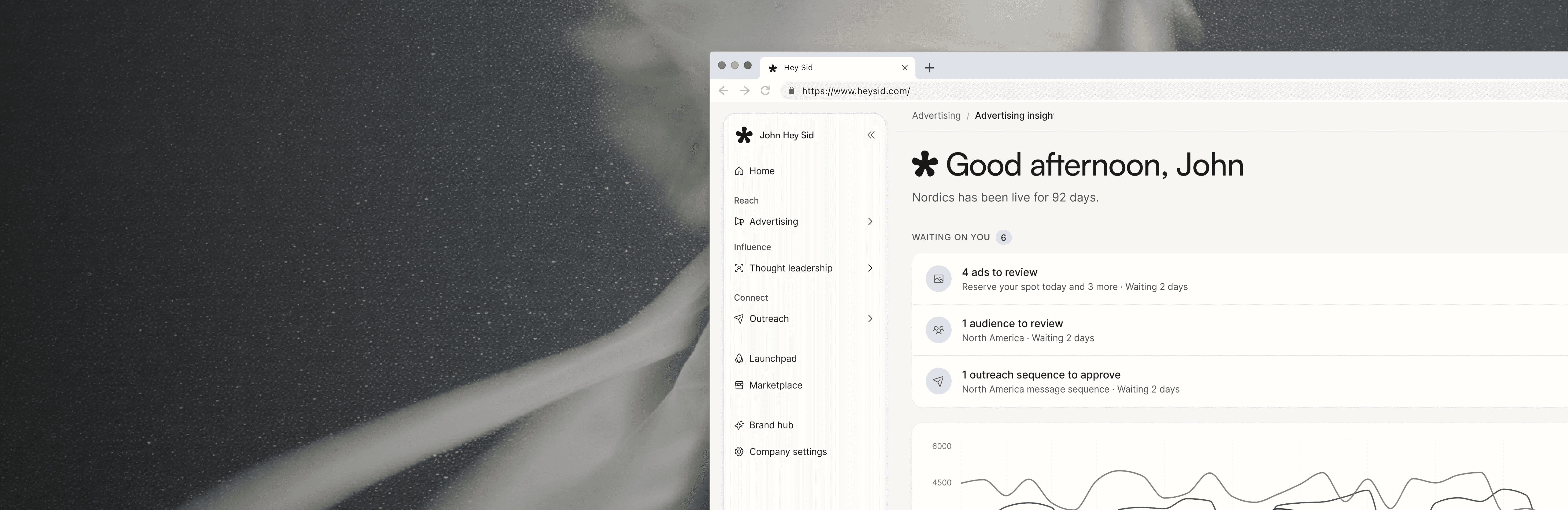
The Influence Loop makes this operational. Hey Sid coordinates personal branding (Authority Builder) with company advertising (Always On) and outreach (Precision Connect). The same target decision-makers see the founder's thought leadership posts, the company's ads, and a personalized LinkedIn connection request - all within the same timeframe. Personal brand and business brand work as one system.
How to Build Each Brand
Building a personal brand (clarity and consistency, not constant visibility):
Define who you help, what problems you solve, and what makes your perspective different
Align your LinkedIn profile and digital presence with that positioning
Share insights and real experiences, not promotional content
Stay consistent in message and cadence so trust compounds over time
Building a business brand (alignment, not noise):
Define who you serve and why the business matters
Make messaging, visual identity, and customer experience reinforce one promise
Keep that promise consistent across sales, marketing, and delivery
Systemize the trust your founders create so the brand can scale independently
Hey Sid's Influence Loop operationalizes both at once: Authority Builder develops the executive personal brands, Always On builds the company's ad presence, and Precision Connect bridges the two with targeted outreach to the same accounts.
Common Mistakes in Balancing Personal and Business Brands
Mistake 1: Treating them as competing priorities
Some companies view personal branding as a distraction from company marketing. In practice, executive content feeds company pipeline. A founder's LinkedIn post that generates 50 inbound profile views drives people to the company's website, product pages, and demo form. The two brands amplify each other.
Mistake 2: Building a personal brand that is disconnected from the company
A founder who posts about general leadership and productivity tips builds a personal following but generates no pipeline for their company. Your personal brand content should be relevant to the problems your company solves, the market you serve, and the buyers you want to attract.
Mistake 3: Relying entirely on company brand in a relationship-driven market
Enterprise software companies that invest millions in company advertising but have invisible leadership teams lose deals to smaller competitors with visible, credible founders. Buyers want to know who they are doing business with.
Mistake 4: Building the founder's brand but ignoring the broader team
The strongest personal branding programs extend beyond the CEO. VPs, directors, and subject matter experts who post consistently create multiple entry points for prospects. Employee advocacy programs multiply your company's reach without proportionally increasing costs.
Practical Framework: How to Allocate Effort
Company Stage | Personal Brand Investment | Business Brand Investment | Ratio |
|---|---|---|---|
Pre-revenue / seed | 80% (founder is the brand) | 20% (basic website and positioning) | 80/20 |
Early growth ($1M-$5M ARR) | 60% (founder + early team) | 40% (product marketing, first campaigns) | 60/40 |
Growth ($5M-$20M ARR) | 40% (founder + leadership team) | 60% (scaled marketing, advertising, content) | 40/60 |
Scale ($20M+ ARR) | 30% (leadership team + employee advocacy) | 70% (brand campaigns, demand gen, ABM) | 30/70 |
For mid-sized B2B companies ($2M-$50M revenue): A 50/50 split is often optimal. Invest in 1-3 executive personal brands (founder plus key leaders) while running company-level advertising and content. Hey Sid's Influence Loop handles both: Authority Builder builds the personal brand, Always On builds the company's ad presence, and Precision Connect bridges the two with targeted outreach.
Conclusion
Personal brands and business brands are not competitors. They are two sides of the same pipeline engine. Your personal brand creates trust and recognition at the individual level. Your business brand creates credibility and confidence at the institutional level. Together, they move prospects from "I have never heard of this company" to "I trust this team and their product."
For mid-sized B2B companies, the practical path is to invest in both simultaneously: build executive thought leadership through consistent LinkedIn content (managed via Authority Builder), run company-level advertising to target accounts (managed via Always On), and coordinate outreach that bridges both brands (managed via Precision Connect).
Build both brands: heysid.com/demo
See the Influence Loop: heysid.com/how-it-works
FAQ
Should my personal brand match my company brand?
They should be aligned but not identical. Your personal brand should be relevant to your company's market and reflect your expertise in the problems your product solves. But your personal brand should also include your individual perspective, stories, and opinions that go beyond product marketing. The overlap is your area of expertise. The difference is your personality.
What if I leave my company? Does my personal brand transfer?
Yes. Your personal brand is portable. LinkedIn followers, audience trust, and thought leadership reputation follow you. Your company brand stays with the company. This is one reason personal branding matters: it creates an asset that compounds regardless of company changes. For companies, this means investing in multiple executives' brands, not just the founder's.
Can a strong company brand substitute for personal branding?
In B2B, rarely. Even companies with strong brands (Salesforce, HubSpot, 6sense) invest heavily in executive visibility. Marc Benioff's personal brand reinforces Salesforce's company brand. Dharmesh Shah's presence reinforces HubSpot. The combination is always stronger than either alone.
Sources
Edelman-LinkedIn, "2024 B2B Thought Leadership Impact Report"
Edelman, "2024 Trust Barometer" (63% say CEO more credible than comms dept)
LinkedIn, "2024 B2B Marketing Benchmark Report" (personal profiles 8x engagement, 4x conversion, 73% lower cost)
6sense, "2025 B2B Buyer Experience Report" (94% rank vendors before contact)
SUCCESS, "How to Build a Personal Brand That Grows Your Business" (2026)
HubSpot, "Personal Branding" (definition of a personal brand)
Edelman, "Trust Barometer" (trust in leadership increases trust in the organization)
Edelman-LinkedIn, "2025 B2B Thought Leadership Impact Report"
Hey Sid, "Authority Builder" (heysid.com/authority-builder)
Hey Sid, "How It Works" (heysid.com/how-it-works)
Personal Branding Hub: Complete Playbook | Why It Matters | LinkedIn Strategies | Resources