ABM Software Pricing in 2026: What B2B Teams Actually Pay
TL;DR
ABM software pricing is mostly quote-only. 6sense and Demandbase do not publish rates. Third-party contract data puts typical annual spend between $60,000 and $70,000, with enterprise deals running past $177,000.
Mid-market options exist. RollWorks starts near $12,000 a year, and HubSpot bundles ABM tools into Marketing Hub from $9,600 a year.
The license is not the real cost. Implementation, data credits, add-on modules, and headcount push total program spend to 2 to 3 times the platform fee.
Budget by stage, not by logo. What you pay should track your account list size and team capacity, not the vendor’s tier names.
Most ABM software pricing pages tell you almost nothing. You click "see pricing," fill out a form, and wait for a sales rep to build a quote around your company size, your data needs, and how much they think you will pay. That opacity is the point. This guide replaces it with real numbers: what 6sense, Demandbase, Terminus, RollWorks, and HubSpot actually charge in 2026, where the hidden costs sit, and how to budget so the contract matches the pipeline you need.
This is written for B2B marketing and revenue leaders evaluating or renewing an ABM platform: demand generation heads, RevOps, and CMOs at companies running lean teams against long sales cycles. If you have been quoted a number and cannot tell whether it is fair, start here.
Why ABM Software Pricing Is So Hard to Pin Down
ABM platforms price on value capture, not on a rate card. Two companies buying the same product can pay figures that differ by 10x. The variables that move your quote:
Account and contact volume. More target accounts and more contacts to enrich means a higher tier.
Modules activated. Intent data, advertising, orchestration, and analytics are often priced separately.
Data credits. Enrichment and intent signals are frequently metered, so usage drives cost.
Seats. Per-user pricing scales with how many people in sales and marketing touch the platform.
Contract length. Almost every ABM platform sells annual contracts, and many push multi-year deals for a discount.
The result: published ranges are wide, and the sticker price is only the starting line. A named-source analysis of ABM contracts found that total program costs, once you add ads, data, and headcount, often run 2 to 3 times the platform fee (Salesmotion, 2026 ABM platform cost analysis).
If you are still deciding which tools you actually need before pricing them, our guide to account-based marketing tools maps the stack layer by layer.
ABM Software Pricing in 2026: What B2B Teams Actually Pay
Here is the comparison most vendors would rather you not have. Figures combine published pricing with third-party contract data from Vendr and ZenABM where vendors keep rates private.
Platform | Pricing model | Typical annual cost | Who it fits |
|---|---|---|---|
6sense | Custom quote, credits-based | Median $63,199; range $11,753 to $177,404 | Enterprise teams that need predictive intent |
Demandbase | Custom quote, modular | Median ~$68,600; range $24,000 to $164,000 | Enterprise ABM with native advertising |
Terminus (DemandScience) | Custom quote | Median ~$23,000 (Vendr); enterprise $250,000+ | Mid-market to enterprise multi-channel ABM |
RollWorks | Tiered, partly public | $12,000 to $50,000; entry near $1,000/mo | Mid-market teams starting structured ABM |
HubSpot (ABM in Marketing Hub) | Public list price | $9,600/yr (Pro) to $43,200/yr (Enterprise) | Teams wanting ABM inside their marketing suite |
Pricing may change. Always check the latest details on the vendor’s website.
Two patterns stand out. The enterprise platforms, 6sense and Demandbase, cluster around $60,000 to $70,000 for a typical contract and scale well past $150,000 for large account lists. The mid-market options, RollWorks and HubSpot, give you a defined entry point under $15,000 but ask you to bring your own campaign execution.
For a fuller feature-by-feature view of these platforms, see our comparison of the top ABM tools for 2026.
Pricing Model by Platform
6sense
6sense does not publish pricing. It sells on predictive intent and account identification, and it meters usage through a credits system that covers data enrichment and contact reveals. Third-party contract data puts the median 6sense deal at $63,199 a year, with smaller contracts around $11,753 and enterprise agreements reaching $177,404 (Vendr, 6sense marketplace). Expect a separate implementation fee and a steep first-quarter ramp while the model calibrates to your data.
Pricing may change. Always check the latest details on the vendor’s website.
Demandbase
Demandbase prices by module. The core account intelligence tier is the base, and advertising, orchestration, and sales intelligence layer on top. Because the platform runs a native DSP, teams that use its advertising add real media spend on top of the license. Vendr contract data shows a median around $68,600 a year, ranging from $24,000 for a focused deployment to $164,000 for a full-suite enterprise contract (Vendr, Demandbase marketplace).
Pricing may change. Always check the latest details on the vendor’s website.
Terminus (now DemandScience)
Terminus merged into DemandScience on November 12, 2024, and the combined company now operates under the DemandScience brand (DemandScience, merger announcement). Pricing stays quote-only. Vendr contract data puts the annual median near $23,000, while a broader range drawn from G2 reviews spans $18,000 to $87,000, and enterprise deployments can reach $250,000+ (ZenABM, Terminus pricing analysis). That keeps it among the more accessible entry points into multi-channel ABM, though buyers should confirm roadmap and support commitments given the ownership change.
Pricing may change. Always check the latest details on the vendor’s website.
RollWorks
RollWorks is the most transparent of the dedicated ABM platforms. It runs tiered plans with an entry point near $1,000 a month, and typical annual contracts land between $12,000 and $50,000 depending on account volume and whether you add its data and advertising features. It fits mid-market teams that want structured account targeting without an enterprise commitment.
Pricing may change. Always check the latest details on the vendor’s website.
HubSpot (ABM in Marketing Hub)
HubSpot does not sell a standalone ABM product. Its account-based tools, target account lists, ABM workflows, and buying-role properties, come bundled inside Marketing Hub. Professional lists at $800 a month billed annually, and Enterprise at $3,600 a month billed annually, which works out to $9,600 and $43,200 a year (HubSpot Marketing Hub pricing). Onboarding fees of $3,000 to $7,000 apply, and contact overages raise the bill. This suits teams already standardized on HubSpot who want ABM features without a second platform.
Pricing may change. Always check the latest details on the vendor’s website.
The Hidden Costs That Multiply Your ABM Bill
The license is the number vendors quote. The program is the number your CFO sees. Four cost centers separate the two:
Implementation and onboarding. Enterprise platforms carry setup fees and a ramp period. HubSpot alone charges $3,000 to $7,000 to onboard.
Data and intent credits. Metered enrichment means your cost rises with usage, not with your plan name. Heavy prospecting quarters cost more.
Add-on modules. Advertising, orchestration, and advanced analytics are often priced outside the base tier. A quote for "the platform" may not include the features you saw in the demo.
Headcount. Someone has to run it. A platform without an operator produces dashboards, not pipeline.
Add these up and the earlier finding holds: total ABM spend often reaches 2 to 3 times the platform fee. A $60,000 license can become a $150,000 program once media, data, and a dedicated hire are counted. Before you sign, model the full program cost. Our guide to ABM budget planning walks through how to allocate across license, media, and execution.
How Much Should You Actually Budget?
Budget by your account list and team capacity, not by the vendor’s tier names.
Early-stage or first ABM program (under 100 target accounts). A mid-market platform at $12,000 to $25,000 a year, or ABM tools inside a suite you already run, is usually enough. Do not buy enterprise intent you cannot act on.
Scaling program (100 to 500 accounts, dedicated owner). Expect $40,000 to $80,000 a year for the platform, plus media and data. This is where 6sense, Demandbase, and Terminus compete.
Enterprise program (500+ accounts, full RevOps function). Platform spend runs $80,000 to $175,000+, and total program cost can pass $300,000 once advertising and headcount are included.
The mistake that wastes the most money: buying an enterprise platform before you have the team to run it. The tool does not generate pipeline. Coordinated execution against named accounts does. To pressure-test whether the spend will pay back, our ABM ROI benchmarks show what a healthy return looks like and how to prove it to finance.
Where a Managed Service Changes the Math
Every platform above sells you software and leaves execution to you. That works when you have the ad ops, creative, data, and outreach talent in-house. Many lean B2B teams do not, which is why the platform fee is only the visible part of the cost.
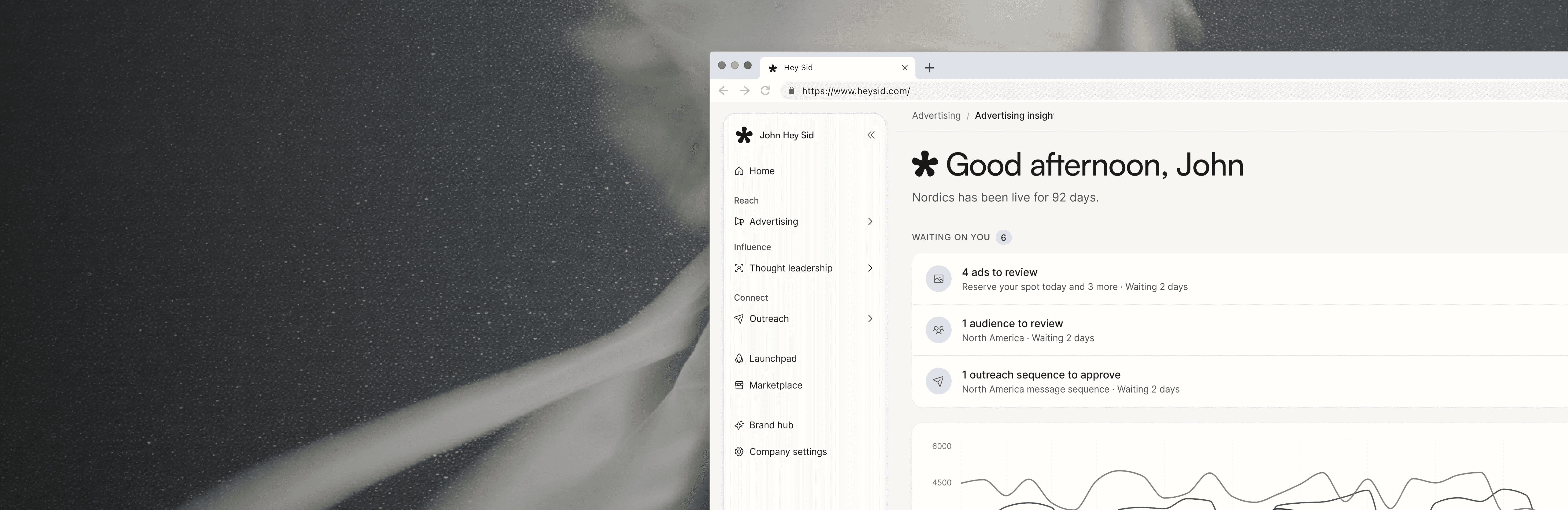
Hey Sid takes a different approach. It is not a platform license you staff and operate. It is a managed ABM service that runs three coordinated motions against the same named decision-makers: Always On for person-level advertising, Precision Connect for automated LinkedIn outreach, and Authority Builder for done-for-you thought leadership. Together these form The Influence Loop.
Why the model matters for cost: you are not paying for a tool and then hiring a team to make it work. The execution is included. The sequence is designed so that by the time Precision Connect sends a message, the prospect has already seen the ads and read the content, which is what compounding familiarity is meant to produce.
The results clients report reflect that coordination. Mercuri International reported 85% reduced ad spend and one of its biggest deals in a decade (client-reported). Devotion Ventures reported 45+ qualified meetings in four months (client-reported). Risk Ident reported 2.5x shorter sales cycles with GDPR compliance built in (client-reported).
Explore Hey Sid: heysid.com/how-it-works
Common ABM Pricing Mistakes to Avoid
Buying tiers you cannot activate
Enterprise intent data is worthless without the team to act on it within days. Match the platform’s capability to your operating capacity, not to your ambition.
Reading the license as the total cost
A $60,000 quote is rarely a $60,000 program. Model implementation, data credits, add-on modules, and headcount before you compare vendors. Otherwise the cheapest sticker price can become the most expensive program.
Locking into multi-year deals early
Vendors discount multi-year contracts because they remove your leverage. In your first ABM year you are still learning your account list and your channel mix. Keep the term short until you know what works.
Ignoring the execution gap
A common reason ABM software underdelivers: no one owns the daily run. If you cannot dedicate an operator, a managed service may cost less per unit of pipeline than a license plus a hire.
Conclusion
ABM software pricing in 2026 splits into two worlds. Enterprise platforms like 6sense and Demandbase run $60,000 to $177,000+ and expect you to bring the execution team. Mid-market tools like RollWorks and HubSpot start under $15,000 but hand you the campaign work. In both cases the license is a fraction of the true program cost, which lands at 2 to 3 times the platform fee once data, media, and headcount are counted.
Budget by your account list and your team’s capacity. If the execution gap is the real constraint, a managed service that includes the run can beat a platform you cannot fully operate. Compare the full landscape in our top ABM tools breakdown, and see how pricing works in an adjacent category in our sales engagement platform pricing guide.
Book a demo: heysid.com/demo
FAQ
How much does ABM software cost in 2026?
Most enterprise ABM platforms run between $60,000 and $70,000 a year for a typical contract, based on third-party data from vendors that keep pricing private. Mid-market options start near $12,000 a year. Total program cost, including data, media, and headcount, often reaches 2 to 3 times the platform fee.
Why don’t ABM vendors publish their pricing?
Platforms like 6sense and Demandbase price on account volume, activated modules, data usage, and seats, so a single rate card would not fit most buyers. Quote-only pricing also lets sales build the number around your company size and perceived budget. That is why published ranges are wide and vary by more than 10x.
Is HubSpot’s ABM cheaper than a dedicated platform?
On license price, yes. HubSpot bundles ABM tools into Marketing Hub from $9,600 a year for Professional, versus $60,000+ for a dedicated enterprise platform. The trade-off is depth: HubSpot’s account-based features are lighter on predictive intent and native advertising than 6sense or Demandbase.
What is the real total cost of an ABM program?
Add the platform license, implementation and onboarding, metered data and intent credits, add-on modules, and at least one operator to run it. Named-source analysis of ABM contracts finds total program cost commonly runs 2 to 3 times the platform fee, so a $60,000 license can become a $150,000 program.
Should a small B2B team buy an enterprise ABM platform?
Usually not first. Under 100 target accounts, a mid-market platform or ABM tools inside a suite you already run is enough. Enterprise intent data only pays back when you have a team ready to act on it within days. Buying capability you cannot activate is a common way teams overspend.
Does a managed ABM service cost more than software?
Not necessarily. A platform license plus a dedicated hire and media budget often exceeds the cost of a managed service that includes execution. The right comparison is cost per unit of pipeline, not license against license.
Sources
Related: Best ABM Tools for 2026 | Account-Based Marketing Tools: What You Actually Need | Sales Engagement Platform Pricing in 2026